Getting found on Google by people nearby
Your Google listing, your reviews and your website: how they work together so people near you find you, and what you can do this week.

“Restaurant near me”, “driving school Fréjus”, “football club Bristol”: every day, people search for exactly what you offer, a few miles from where you are. The first thing they see isn’t a list of websites, it’s a map with three businesses on it. Here’s how to get onto that map, and how to turn the visit into a call.
Two tools that work together
For a local search, Google mostly relies on two things:
- Your Google Business Profile: your name, address, opening hours, photos and reviews, shown on the map.
- Your website: where Google checks what you really do, who for, and in which towns.
The listing catches the eye; the website convinces. A listing without a website leaves visitors with little to go on, and a website without a listing never shows up on the map. Together, each makes the other stronger.
1. A complete, up-to-date Google listing
It’s free, and it’s often what makes the biggest difference:
- Claim your listing if you haven’t already, and check it’s in your name.
- Pick the right main category: “Pizza restaurant” rather than “Restaurant” if that’s what you are. It’s one of the most important signals.
- Fill in everything: opening hours (bank holidays included), phone number, the area you cover if you travel, your services and a link to your website.
- Add real photos: your shopfront, your dining room, your team, your work. Listings with recent photos earn more trust.
2. Reviews, and replies
Reviews matter to Google and to your future customers. Ask for them simply, at the right moment: after a good meal, a driving test passed, a session that helped. A direct link to your listing, on a small card or in a message, is enough.
Reply to every review, the less glowing ones included, calmly and briefly. People read the replies as much as the reviews.
3. A website that says clearly where you are and what you do
Google doesn’t guess, it reads. Your website needs to spell out:
- Your trade and your town in the title and the first sentence: “Driving school in Fréjus” rather than “Welcome”.
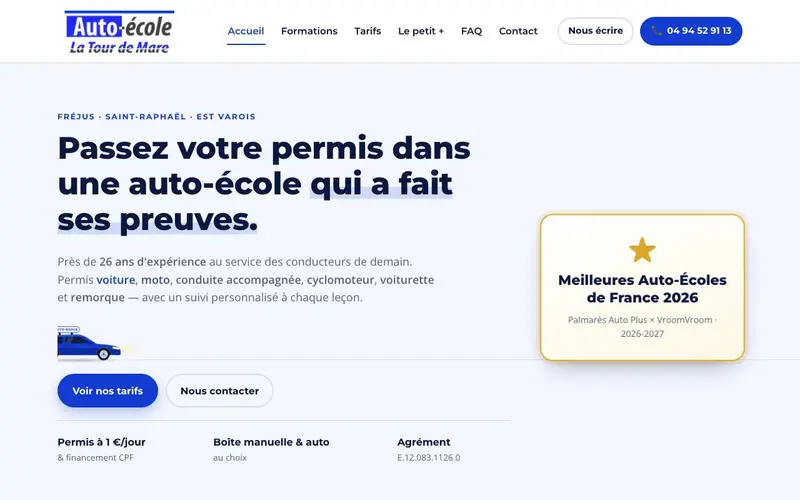
- One page for each important service, with its practical details. On the Auto-école La Tour de Mare site, every course (car, motorbike, accompanied driving) has its own page, so each one can be found on its own.
- The same name, address and phone number as on your Google listing, written exactly the same way.
- The towns you serve, if you travel to customers: not an artificial list, but the places where it’s true and useful.
4. Fast on a phone
Most local searches happen on a phone, often outdoors. If the page is slow to appear, the visitor goes back to the map and calls the next one. A light website, with your hours and a call button visible straight away, keeps those visitors.
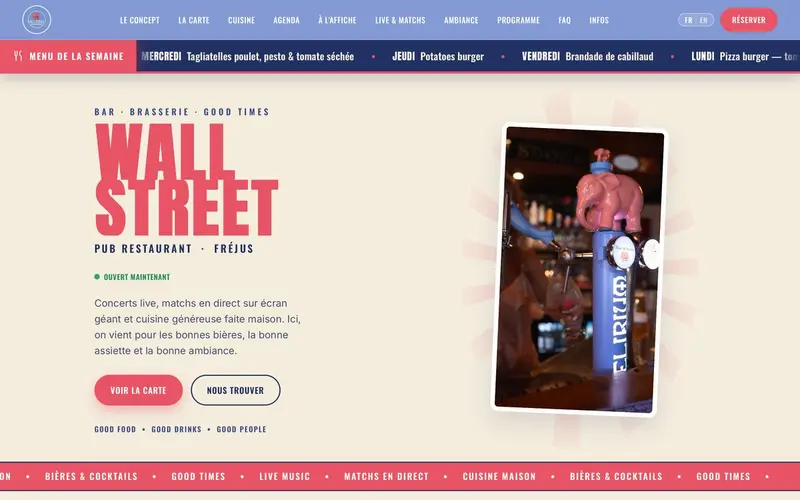
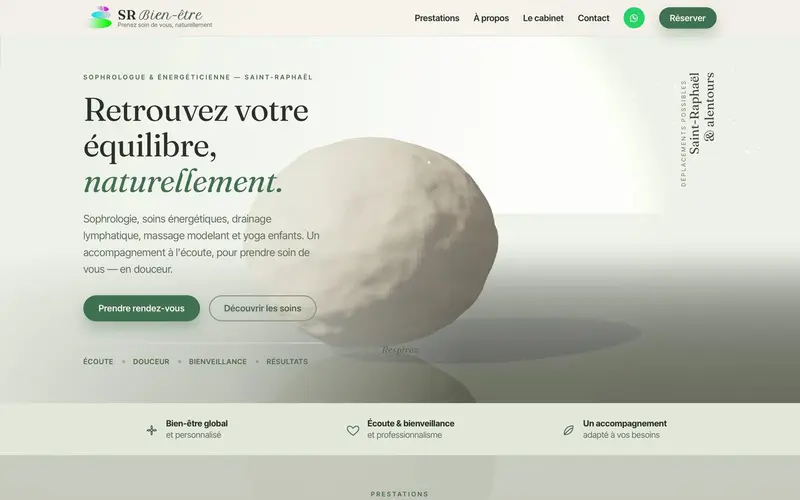
On the Wall Street site in Fréjus, the week’s menu and booking are right there on arrival; on SR Bien-être in Saint-Raphaël, each treatment is described simply, with a clear way to book.
5. What we add “under the bonnet”
Part of the work is invisible, but it helps Google understand your business:
- page titles and descriptions written for search, page by page;
- structured data, which tells Google your address, hours and type of business in machine-readable form;
- registering the site with Google Search Console, to see which searches you appear in and catch problems early.
What you can do this week
- Open your Google listing and check your hours, your category and the link to your website.
- Add five recent photos.
- Ask three happy customers for a review, and reply to any waiting reviews.
- Open your website on your phone: can you see your trade, your town and a way to contact you without scrolling?
If the answer to that last question is no, that’s where we can help. See our live sites, or tell us about your project.